
10 Benefits of Outdoor Play in Early Childhood Development
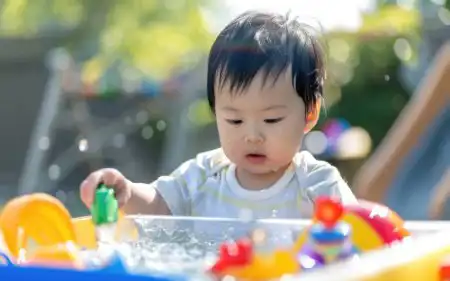
In purposeful early childhood programs, outdoor time is scheduled, protected, and valued. Yet it is often framed as a pause, a chance for children to release energy, or a break for teachers. What if we approached this time as an opportunity to deepen relationships, integrate movement, and extend learning, all within a space that allows for bigger, noisier, and messier experiences?
When we embrace the idea that learning can extend beyond classroom doors, new possibilities take shape. Conversations grow richer. Projects increase in scope and scale. Learning becomes embodied. Outdoor play does not compete with classroom goals, it amplifies them.
Here are ten ways purposeful outdoor play supports early childhood development.
1. Outdoor Play Expands Construction into Engineering
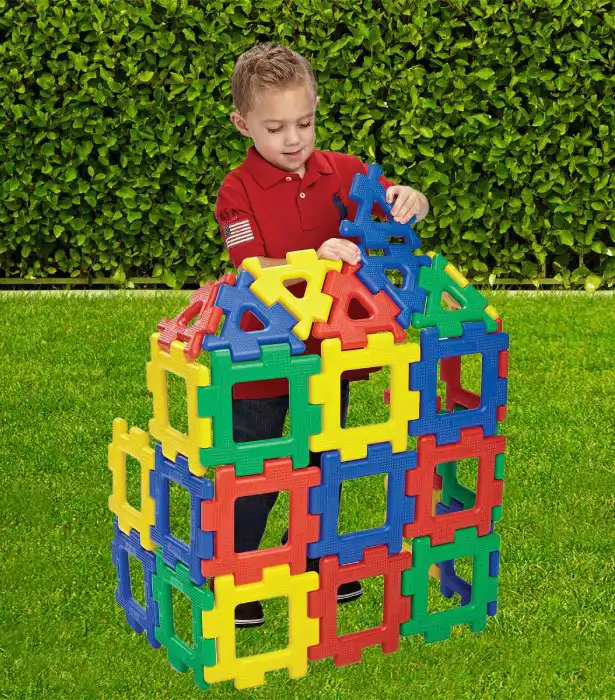
Outdoor spaces allow children to build at a different scale. Loose parts, planks, ramps, crates, and blocks invite collaboration and physical engagement. Children solve problems, brainstorm, and test balance and stability while building bigger, wider, and more creatively.
Because space is less constrained, projects can remain in place and evolve over multiple days. This continuity supports planning, revision, and sustained problem-solving. Construction play can be seen as applied engineering when supported by big body movement and cooperation.
2. Outdoor Play Broadens Creative Expression
Art experiences outdoors often become more expansive. Easels, weaving frames, natural materials, and tools of a different scale encourage larger gestures and experimentation. Children engage their shoulders and arms, not only their wrists and fingers.
The outdoor setting reduces concern about space and mess. This freedom, and the ephemeral nature of outdoor creations, can lead to greater exploration and creative risk-taking. Making art outdoors emphasizes process, scale, and sensory awareness while supporting both fine and gross motor development.
3. Outdoor Play Strengthens Scientific Thinking
Real engagement with the natural world strengthens observation and inquiry. Children notice changes in weather, experiment with water flow, observe plant growth, and study the world around them.
These types of outdoor learning activities allow children to wonder, make predictions, and test ideas in hands-on ways. Scientific thinking becomes grounded in real-life experiences and continuous rather than confined to a single center or lesson. If our goal is to cultivate a scientific mindset, let's consider how to make space for experiences like watching a caterpillar devour a leaf of milkweed or discovering a roly-poly under a rock.
4. Outdoor Play Supports Regulation Through Movement
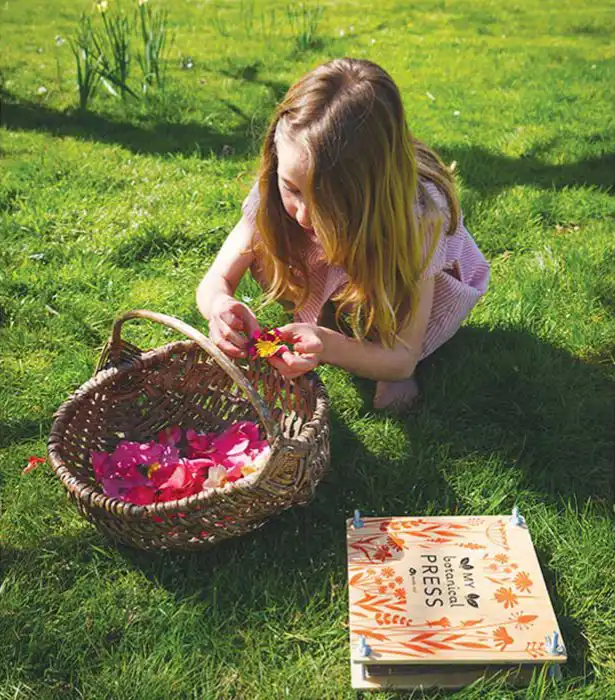
Young children regulate their bodies and build their sensory systems through movement. Running, climbing, carrying, balancing, and navigating wider spaces are foundational to learning. Pushing a wheelbarrow and pumping legs on a swing integrate children’s bodies and brains, and help nervous systems find equilibrium.
Access to meaningful big body movement during outdoor play contributes to emotional steadiness. We often see less conflict when environments offer more choice and more space. These regulatory benefits often continue when children return indoors.
5. Outdoor Play Makes Mathematical Thinking Concrete
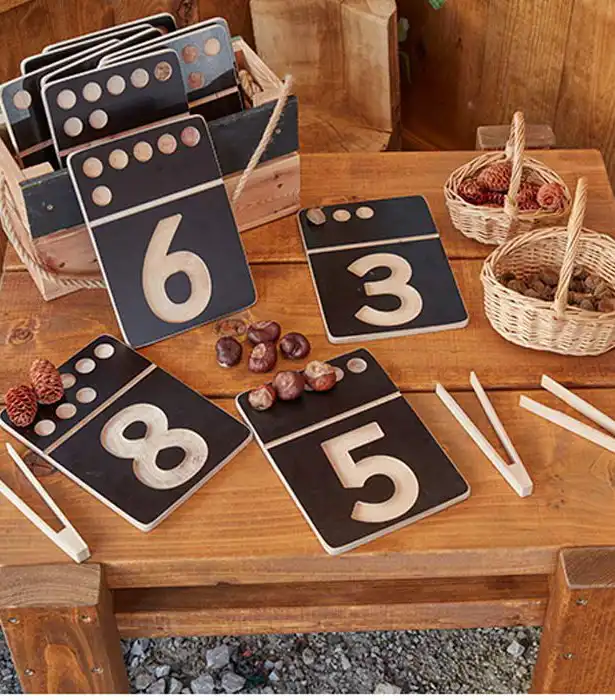
Mathematics outdoors is physical and visible. Children measure distances, compare speeds, estimate weight, count materials, and evaluate height and balance in construction.
These experiences connect mathematical language to lived experience. Concepts such as quantity, symmetry, measurement, and proportion become tangible. Outdoor play strengthens spatial reasoning and problem-solving through hands-on, contextual experiences.
6. Outdoor Play Deepens Language Development
Language grows within exploration and relationships. Outdoor play creates authentic opportunities for conversation, negotiation, creativity, and storytelling.
Outdoor story circles and small world play invite children to connect language to lived experience. A book read beneath a tree or retold beside a garden bed becomes anchored to place. Durable small world materials encourage children to build narratives, assign roles, and sequence parts of a story. Outdoor music invitations help children practice expressive language and listening skills. Songs tied to movement or seasonal changes deepen vocabulary and create joyful, connected shared experiences. Teachers extend language in context, drawing connections between story and environment. Language development outdoors is grounded in interaction, which often increases repetition, retention, and confidence.
7. Outdoor Play Elevates Dramatic Play Scale and Complexity
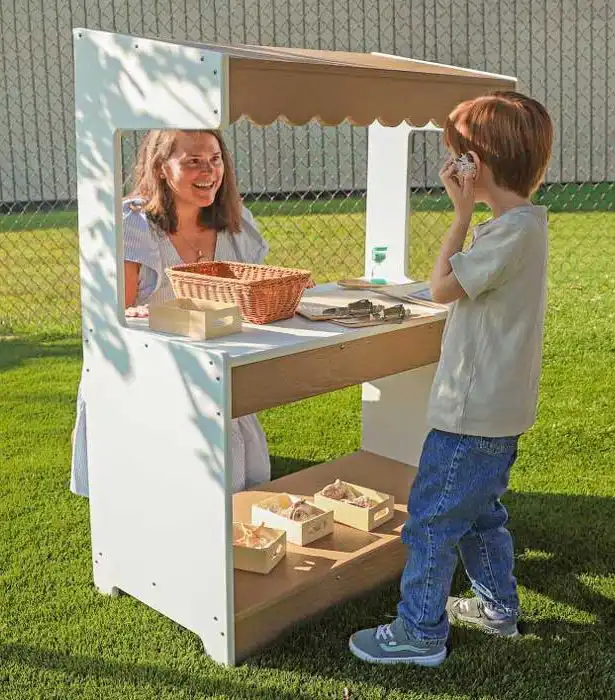
Outdoor play changes the scale of pretend experiences. Mud kitchens, market setups, transportation paths, and construction zones allow for broader group participation. A trike could become an emergency vehicle or a climber may be reimagined as a mountain range.
Children assume roles that require movement and coordination. Resources and supplies are negotiated and transported. Narratives unfold across space rather than within confined corners. The physical environment supports more complex and sustained storylines.
8. Outdoor Play Strengthens Social Connections
Outdoor play supports fluid group interaction. Children move in and out of play groups more easily, and shared projects require negotiation and joint decision-making.
Leadership roles shift naturally within group dynamics. Disagreements are often resolved through repositioning or redesigning the play itself. Outdoor play provides opportunities to practice cooperation within meaningful, child-led scenarios.
9. Outdoor Play Integrates Fine and Gross Motor Development
Outdoor play supports layered development. Children draw with chalk, manipulate natural materials, use tools for gardening, and add detailed elements to large structures.
Fine motor precision develops alongside strength and coordination. Early childhood outdoor play integrates developmental domains within purposeful activity rather than separating them.
10. Outdoor Play Supports Sustainable Classroom Flow
Outdoor play contributes to smoother daily rhythms. Extending centers outside reduces indoor bottlenecks and allows for more flexible grouping, differentiation, and space for children to explore diverse interests and activities.
Planning for intentional outdoor learning activities expands instructional flexibility. Teachers can rotate small groups, continue projects across environments, and respond to children’s interests without squeezing everything into the classroom space and indoor schedule. Fewer transitions feel rushed, and fewer moments escalate simply because space is limited. Over time, this consistency supports a more predictable, sustainable classroom flow for both children and adults.
Leadership Shapes What Becomes Possible
Elevating early childhood outdoor play requires intentional leadership. Culture is shaped through thoughtful scheduling, resource allocation, and visible priorities.
Leaders support purposeful outdoor learning by protecting consistent time outdoors, encouraging teachers to extend curriculum beyond classroom walls, and providing durable, versatile materials. Clear supervision planning and defined play zones contribute to safety and confidence.
No big redesign needed! Extending one area outdoors, documenting outdoor learning activities, and sharing that documentation with families are practical starting points. Small, consistent actions signal that outdoor play is essential to the program’s mission.
Outdoor Play = Outdoor Learning
Outdoor play in early childhood strengthens developmental goals across domains. Cognitive growth, language development, collaboration, regulation, and creativity often occur simultaneously outdoors.
When programs approach outdoor time, space, and materials with intention, it comes into focus as an authentic continuation of learning. The environment itself does not determine the outcome. The mindset does. Outdoor play and outdoor learning are not competing priorities; they are interconnected. And together, they expand how and where children grow.
In purposeful early childhood programs, outdoor time is scheduled, protected, and valued. Yet it is often framed as a pause, a chance for children to release energy, or a break for teachers. What if we approached this time as an opportunity to deepen relationships, integrate movement, and extend learning, all within a space that allows for bigger, noisier, and messier experiences?
When we embrace the idea that learning can extend beyond classroom doors, new possibilities take shape. Conversations grow richer. Projects increase in scope and scale. Learning becomes embodied. Outdoor play does not compete with classroom goals, it amplifies them.
Here are ten ways purposeful outdoor play supports early childhood development.
1. Outdoor Play Expands Construction into Engineering
Outdoor spaces allow children to build at a different scale. Loose parts, planks, ramps, crates, and blocks invite collaboration and physical engagement. Children solve problems, brainstorm, and test balance and stability while building bigger, wider, and more creatively.
Because space is less constrained, projects can remain in place and evolve over multiple days. This continuity supports planning, revision, and sustained problem-solving. Construction play can be seen as applied engineering when supported by big body movement and cooperation.
2. Outdoor Play Broadens Creative Expression
Art experiences outdoors often become more expansive. Easels, weaving frames, natural materials, and tools of a different scale encourage larger gestures and experimentation. Children engage their shoulders and arms, not only their wrists and fingers.
The outdoor setting reduces concern about space and mess. This freedom, and the ephemeral nature of outdoor creations, can lead to greater exploration and creative risk-taking. Making art outdoors emphasizes process, scale, and sensory awareness while supporting both fine and gross motor development.
3. Outdoor Play Strengthens Scientific Thinking
Real engagement with the natural world strengthens observation and inquiry. Children notice changes in weather, experiment with water flow, observe plant growth, and study the world around them.
These types of outdoor learning activities allow children to wonder, make predictions, and test ideas in hands-on ways. Scientific thinking becomes grounded in real-life experiences and continuous rather than confined to a single center or lesson. If our goal is to cultivate a scientific mindset, let's consider how to make space for experiences like watching a caterpillar devour a leaf of milkweed or discovering a roly-poly under a rock.
4. Outdoor Play Supports Regulation Through Movement
Young children regulate their bodies and build their sensory systems through movement. Running, climbing, carrying, balancing, and navigating wider spaces are foundational to learning. Pushing a wheelbarrow and pumping legs on a swing integrate children’s bodies and brains, and help nervous systems find equilibrium.
Access to meaningful big body movement during outdoor play contributes to emotional steadiness. We often see less conflict when environments offer more choice and more space. These regulatory benefits often continue when children return indoors.
5. Outdoor Play Makes Mathematical Thinking Concrete
Mathematics outdoors is physical and visible. Children measure distances, compare speeds, estimate weight, count materials, and evaluate height and balance in construction.
These experiences connect mathematical language to lived experience. Concepts such as quantity, symmetry, measurement, and proportion become tangible. Outdoor play strengthens spatial reasoning and problem-solving through hands-on, contextual experiences.
6. Outdoor Play Deepens Language Development
Language grows within exploration and relationships. Outdoor play creates authentic opportunities for conversation, negotiation, creativity, and storytelling.
Outdoor story circles and small world play invite children to connect language to lived experience. A book read beneath a tree or retold beside a garden bed becomes anchored to place. Durable small world materials encourage children to build narratives, assign roles, and sequence parts of a story. Outdoor music invitations help children practice expressive language and listening skills. Songs tied to movement or seasonal changes deepen vocabulary and create joyful, connected shared experiences. Teachers extend language in context, drawing connections between story and environment. Language development outdoors is grounded in interaction, which often increases repetition, retention, and confidence.
7. Outdoor Play Elevates Dramatic Play Scale and Complexity
Outdoor play changes the scale of pretend experiences. Mud kitchens, market setups, transportation paths, and construction zones allow for broader group participation. A trike could become an emergency vehicle or a climber may be reimagined as a mountain range.
Children assume roles that require movement and coordination. Resources and supplies are negotiated and transported. Narratives unfold across space rather than within confined corners. The physical environment supports more complex and sustained storylines.
8. Outdoor Play Strengthens Social Connections
Outdoor play supports fluid group interaction. Children move in and out of play groups more easily, and shared projects require negotiation and joint decision-making.
Leadership roles shift naturally within group dynamics. Disagreements are often resolved through repositioning or redesigning the play itself. Outdoor play provides opportunities to practice cooperation within meaningful, child-led scenarios.
9. Outdoor Play Integrates Fine and Gross Motor Development
Outdoor play supports layered development. Children draw with chalk, manipulate natural materials, use tools for gardening, and add detailed elements to large structures.
Fine motor precision develops alongside strength and coordination. Early childhood outdoor play integrates developmental domains within purposeful activity rather than separating them.
10. Outdoor Play Supports Sustainable Classroom Flow
Outdoor play contributes to smoother daily rhythms. Extending centers outside reduces indoor bottlenecks and allows for more flexible grouping, differentiation, and space for children to explore diverse interests and activities.
Planning for intentional outdoor learning activities expands instructional flexibility. Teachers can rotate small groups, continue projects across environments, and respond to children’s interests without squeezing everything into the classroom space and indoor schedule. Fewer transitions feel rushed, and fewer moments escalate simply because space is limited. Over time, this consistency supports a more predictable, sustainable classroom flow for both children and adults.
Leadership Shapes What Becomes Possible
Elevating early childhood outdoor play requires intentional leadership. Culture is shaped through thoughtful scheduling, resource allocation, and visible priorities.
Leaders support purposeful outdoor learning by protecting consistent time outdoors, encouraging teachers to extend curriculum beyond classroom walls, and providing durable, versatile materials. Clear supervision planning and defined play zones contribute to safety and confidence.
No big redesign needed! Extending one area outdoors, documenting outdoor learning activities, and sharing that documentation with families are practical starting points. Small, consistent actions signal that outdoor play is essential to the program’s mission.
Outdoor Play = Outdoor Learning
Outdoor play in early childhood strengthens developmental goals across domains. Cognitive growth, language development, collaboration, regulation, and creativity often occur simultaneously outdoors.
When programs approach outdoor time, space, and materials with intention, it comes into focus as an authentic continuation of learning. The environment itself does not determine the outcome. The mindset does. Outdoor play and outdoor learning are not competing priorities; they are interconnected. And together, they expand how and where children grow.

Christine Murray, Early Learning Pedagogy and Product Lead
Christine Murray is an Early Learning Pedagogy and Product Lead with Becker’s Education Team.
As an educator, coach and leader, Christine is inspired by the curiosity, joy and wonder that children so generously model for us. She earned her M.A. in Innovative Early Childhood Education at the University of Colorado Denver and loves collaborating with and supporting others in the field. Grounded in relationships and guided by empathy, Christine is always learning, connecting and creating.
Christine Murray, Early Learning Pedagogy and Product Lead
Christine Murray is an Early Learning Pedagogy and Product Lead with Becker’s Education Team.
As an educator, coach and leader, Christine is inspired by the curiosity, joy and wonder that children so generously model for us. She earned her M.A. in Innovative Early Childhood Education at the University of Colorado Denver and loves collaborating with and supporting others in the field. Grounded in relationships and guided by empathy, Christine is always learning, connecting and creating.