
Difference between Sensory Play and Sensory Regulation
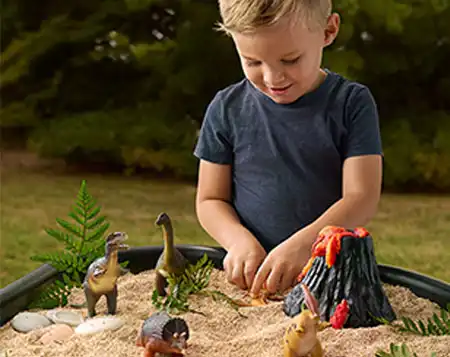
Sorting Out Sensory Play and Sensory Regulation
in Early Childhood Education
Making Sense of ECE’s Most Multitasking Word
There was a time in early childhood education when “sensory play” was synonymous with the sand and water table. We had a shared understanding of the purpose, the benefits, and the real-life challenges of this iconic learning center. Sand slips through fingers, water sloshes from one cup to another, and children negotiate turns with the funnel that “doesn’t work” until it’s tipped just right. It’s a place where big ideas come to life in small hands: What if I pour faster? Which one holds more? How do I make it flow?
Teachers have a clear role in this version of open-ended sensory exploration: plan thoughtful setups, introduce expectations, provide functional tools, and stay close enough to notice and extend the learning that’s unfolding. The value of the sensory table doesn’t need much explanation. It supports learning across domains while inviting focus, collaboration, and deep engagement. It’s open-ended by design, revisited day after day, and flexible enough to grow with the children using it.
Over time, our understanding of children’s sensory systems has expanded, and our sensory tools have grown beyond the sand and water table. This is a good thing! We now understand that sensory input isn’t just something children enjoy. It’s something their bodies and brains actively use to feel safe, organized, alert, or regulated. This knowledge has expanded how educators think about environments, materials, and daily routines. With this growth, we’ve collected a toolbox of new resources and strategies: spaces to be cozy and spaces to move, materials providing various textures, and tools to reduce or manage sensory input. These matter deeply, especially for children whose nervous systems need more intentional input to participate fully in classroom life. Not surprisingly, many of these materials and experiences began to share the same label: sensory.
This is where confusion can creep in. Not because we're doing anything wrong, but because the word itself is doing a lot of work.
Sensory Exploration and Discovery Play
Some sensory experiences are designed primarily for exploration and learning.
These are the experiences that feel familiar from the sand and water table, a Tuff Tray in the outdoor classroom, or the art table set out with playdough and tools. Children investigate, test ideas, repeat actions, make changes, and notice what happens. The materials are open-ended. The play is self-directed. The learning unfolds over time.
You’ll often see:
- • Scooping, pouring, filling, dumping, and transferring
- • Mixing materials together and pulling them apart
- • Loose parts combined in new ways
- • Playdough, clay, finger paint, or other tactile art invitations
- • Children returning again and again to refine an idea
These experiences support fine motor development, early math and science thinking, language, creative meaning-making, collaboration, and persistence. They also tend to be regulating for many children. In these examples, regulation is a welcome byproduct, not the primary goal.
The educator’s role looks a lot like it always has. Prepare the environment. Make sure materials are safe, functional, and inviting. Observe closely. Add language, vocabulary, or a wondering when it deepens the play. Protect time so children can stay with their thinking, return to an idea, and test it again.
This is sensory play in early childhood, and it remains a cornerstone of early childhood experiences.
Sensory Experiences Designed for Regulation
Other sensory experiences are designed with a different intention in mind.
These supports are less about investigation and more about helping children feel regulated, centered, and ready to engage. They’re rooted in what we now understand about how sensory input like pressure, movement, and resistance can help children regulate their bodies and emotions.
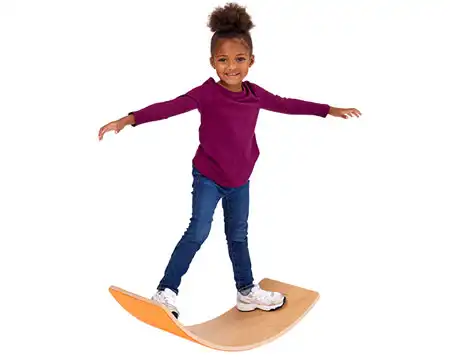 You might see:
- • Visual tools that support sensory regulation
- • Materials that offer deep pressure or soft resistance, such as a Cuddle Ball or weighted animal
- • Movement and balance supports like balance boards, wiggle cushions, or low spinning elements
- • Cozy spaces and soft furnishings that offer respite from the busyness of the classroom
- • Handheld tactile tools like fidgets, textured manipulatives, worry stones, or squishable materials, offered with clear expectations and purpose
These experiences are often responsive to the moment. They may be offered during transitions, after periods of high stimulation, or when a child is having a hard time staying organized in their body. They can be essential supports for some children, and helpful options for many others.
Here, the adult’s role is intentional, responsive, and grounded in co-regulation: notice what a child is communicating through their behavior, offer sensory input that matches what their body seems to be asking for, adjust as needed. These supports are not about staying for a long stretch of play, but about supporting sensory regulation in early childhood, and helping a child rejoin the rhythm of the day.
Clarity Matters
When all of these experiences are grouped under the same umbrella of sensory activities or sensory materials, it becomes harder to plan with intention, communicate effectively, and collaborate well.
When the lines get blurry, exploratory sensory play can start to feel overly structured or time-limited. Regulation tools may be misunderstood as centers children are expected to “play” in. Families may wonder what their children are learning or why certain materials are present. Program leaders may struggle to evaluate balance and quality across classrooms.
Purposeful language helps everyone understand what’s happening and why.
- • It helps educators ask, What is the purpose of this experience: exploration, regulation, or something that shifts across the day?
- • It helps leaders align environment, materials, professional development, and coaching to the right goals.
- • It gives families a clearer window into their child’s development, challenges, successes, and delights.
The Balance That Works
High-quality early learning environments don’t position sensory play vs sensory regulation. They plan intentionally for each. They offer rich, open-ended sensory play that invites children to investigate, revisit, and think big. They also provide thoughtful sensory supports that help children feel grounded, engaged, and ready to participate.
In many ways, this brings us back to what we always knew at the sand and water table. Thoughtful setup matters. Time matters. Adult awareness matters. When materials, space, and purpose are aligned, sensory experiences support learning, regulation, and connection, all at once. As our field grows, our practice grows with it. New insights lead to new tools, new routines, and sometimes new interpretations of familiar words.
The goal is bigger than terminology; it’s about shared understanding. When we’re more purposeful with the words we use, it becomes easier to design environments and communities that truly work for children and the adults supporting them.

Christine Murray is an Early Learning Pedagogy and Product Lead with Becker’s Education Team.
As an educator, coach and leader, Christine is inspired by the curiosity, joy and wonder that children so generously model for us. She earned her M.A. in Innovative Early Childhood Education at the University of Colorado Denver and loves collaborating with and supporting others in the field. Grounded in relationships and guided by empathy, Christine is always learning, connecting and creating.