
Early Childhood Sensory Exploration and Tactile Play
Sensory Exploration and Play in
Early Childhood Education
Sensory play in early childhood education is a foundational way young children explore, learn, and make meaning through their bodies and senses. Long before children can explain their thinking with words, they are actively learning through touch, movement, and hands-on interaction with materials. Sensory exploration and play give children opportunities to investigate the world in ways that feel natural, engaging, and developmentally appropriate, supporting growth across cognitive, language, social-emotional, and physical domains.
Through intentional sensory and tactile play in early childhood settings, children build understanding by touching, manipulating, testing, and transforming materials. These experiences allow children to ask questions, notice changes, and explore cause and effect in real time. Sensory play is not an “extra” or enrichment activity added when time allows—it is a core component of how young children learn best and a meaningful part of high-quality early learning environments.
What Is Sensory and Tactile Play?
Sensory and tactile play in early childhood refers to experiences that invite children to explore materials using their senses, especially touch. In early childhood classrooms, this often looks like open-ended opportunities to feel, scoop, pour, press, squeeze, stack, arrange, and experiment with a variety of materials. Common examples include sand and water play, dough and clay, loose parts, textured objects, and other materials that encourage hands-on investigation.
As children engage in sensory exploration and play with sensory materials, such as sand, water, or dough, they actively investigate material properties, physical relationships, and cause-and-effect interactions. They notice what happens when materials are combined, separated, moved, or transformed. This kind of learning is concrete, physical, and deeply meaningful, helping children connect abstract ideas to real-world experiences through their bodies and senses.
Sensory Exploration and Discovery
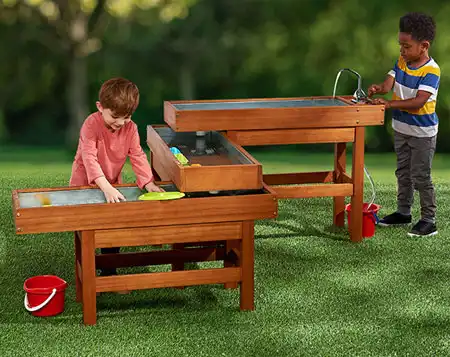
Sensory exploration and discovery focus on how children investigate materials and phenomena through hands-on play. These experiences are designed to support curiosity, inquiry, and learning by allowing children to explore freely and make their own discoveries. Sensory tables, sand and water tables, Tuff Trays, discovery tables, and loose-parts exploration are common examples of sensory exploration tools used in early childhood classrooms.
In these spaces, the goal is learning through play. Children test ideas, observe changes, and build understanding by interacting with materials in open-ended ways. Educators support this process by selecting developmentally appropriate materials, offering simple prompts or vocabulary, and allowing children the time and space to explore deeply.
Sensory Comfort and Self-Regulation
Sensory comfort and self-regulation tools serve a different, but equally important, role in early childhood settings. These supports are designed to help children feel safe, calm, and regulated within the classroom environment. Cozy spaces, soft seating, fidgets, weighted items, movement tools, and calming materials help support emotional regulation, physical inclusion, and overall well-being.
While sensory exploration supports learning through investigation, sensory regulation tools support children’s ability to participate fully in classroom experiences. Both are essential, but they serve different developmental purposes and should be planned intentionally to meet children’s needs. To learn more, read our Sensory Play vs. Sensory Regulation in Early Childhood blog.
Benefits of Sensory Play for Preschoolers
Sensory and tactile play supports preschool-aged children’s learning and development in meaningful, interconnected ways. Through shared sensory experiences, children build skills across multiple domains at once. Sensory play helps preschoolers develop language as they describe textures, actions, and changes, and it encourages social interaction through collaboration, turn-taking, and shared problem-solving.
These experiences also provide natural opportunities for conflict resolution as children negotiate space, materials, and ideas. Sensory play promotes inquiry and curiosity as children predict outcomes, experiment with materials, and observe results. It often extends into dramatic and imaginative play, with materials becoming props, symbols, and story elements.
In addition, sensory play strengthens emerging literacy skills through storytelling and oral language, builds early math concepts such as counting, measuring, comparing, and estimating, and develops fine motor skills through scooping, pouring, squeezing, and manipulating materials. Open-ended sensory experiences encourage creativity and flexible thinking, allowing children to explore without a single “right” outcome.
Sensory and Tactile Play for Infants and Toddlers
For infants and toddlers, sensory and tactile play is especially important because learning is rooted in physical exploration and repetition. Sensory experiences support early communication through gestures, sounds, facial expressions, and shared attention with caregivers and peers. They also encourage early social connections through parallel play and emerging turn-taking behaviors.
Young children explore sensory materials by touching, mouthing, dumping, and repeating actions, which strengthens cause-and-effect understanding and supports early problem-solving skills. Predictable sensory experiences can also help lay the foundation for self-regulation by offering comfort, familiarity, and consistency.
Through grasping, transferring, and manipulating objects, infants and toddlers develop fine motor skills and hand-eye coordination. Sensory play introduces early math concepts such as full and empty, more and less, and spatial relationships. Over time, these experiences begin to support early imaginative play, as materials take on meaning and represent ideas and actions.
Why Sensory Exploration Matters
Sensory exploration and tactile play help children learn in ways that are developmentally appropriate, inclusive, and deeply engaging. By providing intentional, non-food-based sensory experiences, early childhood educators support curiosity, confidence, and foundational learning skills that children carry forward into future learning.
Thoughtfully designed sensory environments honor how young children learn best—through hands-on discovery, meaningful interaction, and play. When educators intentionally plan for both sensory exploration and sensory regulation, they create classrooms that support learning, well-being, and belonging for every child.