
The Ultimate Guide to Setting Up a Dramatic Play Center
Planning Your Early Learning Classroom for the Year Ahead
With summer setup just around the corner, now is the perfect time to plan a dramatic play center that will spark imagination, build skills, and serve as the social heart of your classroom. Whether you're refreshing an existing space or starting from scratch, this guide walks you through everything you need to design a dramatic play area that supports the whole child.
Why Dramatic Play Matters
The National Association for the Education of Young Children (NAEYC) is clear: through play, children “explore and make sense of their world, develop imaginative and symbolic thinking, and develop physical competence.” Preschool dramatic play has been linked to gains in social-emotional development, language and literacy, and problem-solving. When a child becomes a doctor, a baker, or a bus driver — even for ten minutes — they're rehearsing real-world thinking, building vocabulary, negotiating roles with peers, and stretching the executive-function muscles that underpin everything from kindergarten readiness to long-term academic success.
In short: dramatic play isn't a break from learning. It is learning.
Dramatic Play Themes & Types
A great dramatic play center isn't a single static setup — it's a flexible space that rotates through themes children connect with. Common categories include:
- Home & family: Kitchens, nurseries, laundry stations — common favorites drawn from home life.
- Community helpers: Doctor's offices, fire stations, post offices, veterinary clinics — children love to step into the roles they see in their world.
- Markets & shops: Grocery stores, bakeries, ice cream shops, flower shops — strong settings for math and literacy integration.
- Workplaces: Construction sites, restaurants, hair salons, car garages — exposing children to a wide range of careers.
- Worlds of imagination: Castles, cosmic rocket, underwater scenes, dinosaur digs — pure pretend that builds storytelling and abstract thinking.
- Cultural & seasonal themes: Heritage-specific bakeries, holidays families celebrate, harvest markets, winter cocoa stands — building belonging by celebrating the cultures and traditions.
NAEYC recommends listening to children's everyday talk to identify themes that genuinely resonate. When one teacher's class kept talking about their families' visits to a panadería, she turned the dramatic play area into one. The result: deeper engagement and richer language development. Plan to rotate themes every four to six weeks to keep play fresh while giving children enough time to develop sustained, complex storylines.
What Products to Use
Quality matters. Dramatic play furniture takes a beating — it gets climbed on, rearranged, dragged across the rug, and stress-tested by every child in your room. When ordering for the new year, look for:
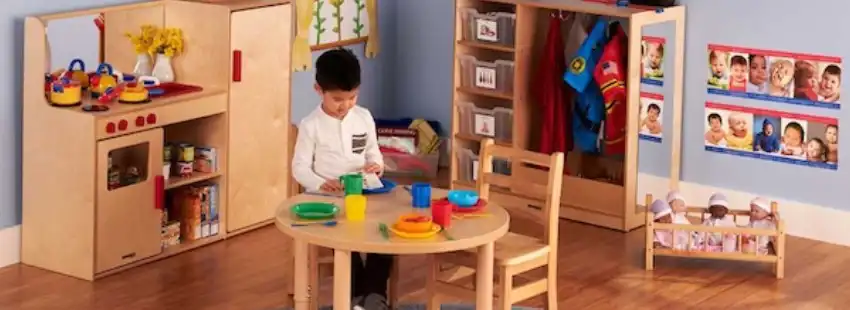
- Durable wood furniture: A sturdy play kitchen, market stand, or workbench will last for years. Look for solid construction, smooth edges, and finishes that hold up to daily wiping.
- Open-ended props & loose parts: Wooden food sets, fabric scraps, baskets, scarves, and unstructured “stuff” children can repurpose. Open-ended materials let children decide what something becomes, which research links to stronger problem-solving and divergent thinking.
- Real or realistic tools: Real telephones, working timers, real measuring cups, cash registers with actual buttons. The more authentic the prop, the deeper the play.
- Inclusive dolls & figures: Dolls that reflect the range of skin tones, abilities, and family structures in your community.
- Dress-up that works: Costumes that go on and off easily, mirrors at child height, hooks within reach. Skip elaborate costumes that frustrate small hands.
- Literacy-rich props: Notepads, menus, order pads, real books, environmental-print signs.
Becker's lifetime-warranty-backed classroom furniture is built specifically for this kind of daily wear. When you see the Becker's Lifetime Warranty logo, you know the piece is made to last — useful when you're outfitting a center that's going to be used hard, every day, for years.
Location: Where to Put the Center
Where a center lives in your classroom shapes how children use it.
- Choose a corner: Two solid walls give children a sense of enclosure and let you display environmental print, family photos, and theme-related signage.
- Keep loud near loud: Active centers (dramatic play, blocks) belong together, opposite quiet centers, such as writing and library.
- Watch your sightlines: You should be able to see the whole center from anywhere in the room — both for safety and for noticing the rich learning moments that warrant a teacher prompt.
- Plan for traffic: Don't position the center on the path to the bathroom or cubbies, where it'll constantly get walked through.
- Light it well: When possible, bring the space to life with natural light. Overhead lighting will cast shadows on small details like food labels and order tickets.
Space & Setup
Aim for a footprint that comfortably fits four to six children at once without crowding. Generally, a typical preschool dramatic play center requires 35 to 40 square feet.
- Define the boundaries: Use furniture (such as a kitchen or market stand) to create the “walls” of the space. Some teachers add a child-safe gazebo, canopy, or curtain to cue children that they're stepping into a different world.
- Include a table & chairs: Even one small table opens dozens of play scenarios — meals, doctor's appointments, restaurant orders, and family meetings.
- Add child-height storage: Shelves, hooks, and bins or baskets that children can reach and reset themselves are essential. If they can't put it away, they won't.
- Leave room to move: Children need physical space to walk through doors, swing aprons on, and act out big movement. Cramped spaces lead to conflict.
Organization: The Make-or-Break Detail
Organization is what separates a dramatic play center that thrives from one that becomes a daily mess.
- Label everything with words & pictures: A picture of a wooden carrot on the carrot bin lets pre-readers participate in cleanup.
- Use clear, sturdy bins or open baskets: Use on shelves or in closets. One bin equals one theme.
- Build “prop boxes” by theme: Keep each theme's specific props (vet kit, bakery aprons, post office stamps) in a labeled box. When you rotate themes, you're swapping one box for another, not rebuilding from scratch.
- Display, don't dump: Hang pots on hooks, line up cans on the market shelf, prop dolls in beds. The way materials are presented signals to children how to engage with them.
- Make it kid-resettable: Children should be able to put the room back together at cleanup time without an adult micromanaging every step.
Tips for Success
- Introduce new props with intention: NAEYC recommends either letting children discover new materials first or modeling them through teacher role-play. Avoid the dump-and-go approach.
- Get on the floor: Sit at child height, observe, and play alongside without taking over. Your participation extends play; your direction tends to shut it down.
- Ask open-ended questions: “What's happening at the bakery today?” beats “What color is the cake?” every time.
- Protect long stretches of play: Sustained dramatic play (think 45+ minutes) is where the deepest learning happens. Resist over-scheduling.
- Involve children in setup: Letting children help theme the next iteration builds investment and ownership.
- Refresh, don't overhaul: Rotating themes is great, but constantly changing every detail can disrupt the deep play children build over weeks.
Activities to Try
Looking for dramatic play ideas to incorporate into your early learning classroom? A few starting points to get a new theme moving:
- Bakery: Children make playdough cinnamon rolls, write order tickets, count change, and sell their goods to “customers.”
- Veterinary clinic: Stuffed animals get checkups, X-rays (hint: foil works), bandages, and follow-up appointments. Add clipboards for charts.
- Grocery store: Real (empty) food packaging, baskets, a pretend register, weekly “ad” flyers children can read.
- Pizza parlor: Felt toppings, paper menus, phone for order-taking, aprons, oven mitts.
- Garden center: Seed packets, watering cans, pots, fabric flowers, “for sale” signs.
- Travel agency: Maps, tickets, brochures, suitcases — perfect for connecting to social studies units.
Connecting Dramatic Play to Curriculum
This is where dramatic play earns its keep with administrators. The same center supports nearly every domain:
- Literacy: Children read menus, write receipts, take orders, sound out signs, and develop narrative structure. NAEYC notes that authentic dramatic play leads to children's meaningful learning — especially in language and vocabulary.
- Math: Pretend cashiers count, add, and make change. Bakery customers measure, compare quantities, and divide cookies fairly. Setting the table for four practices one-to-one correspondence.
- Science: A garden center introduces seeds, growth, and weather. A vet clinic touches on living things and life cycles. A construction site explores materials and tools. STEAM is built into authentic role-play.
- Social-emotional: Children practice turn-taking, perspective-taking, and conflict resolution every time they negotiate roles (“You be the baby this time”).
- Social studies & community: Roles like firefighter, doctor, store clerk, or postal worker introduce community structures and the helpers in them.
When teachers tell families what they're seeing at school, this is often where the ah-ha lands: the child who “just plays” is actually doing math, literacy, and science — every single day.
What's Trending in 2026
A few shifts worth designing around as you plan for the new year:
- Loose parts everywhere: Open-ended natural and recycled materials — pinecones, fabric scraps, wooden rings, bottle caps — continue to grow. They're inexpensive, sustainable, and rich in learning. Recent systematic reviews link loose parts play to gains in cognitive development.
- Culturally responsive themes: Centers that reflect the specific families in your room — their languages, foods, holidays, work — rather than generic “multicultural” props. Invite families to contribute objects, recipes, or stories.
- Sustainability & stewardship play: Recycling centers, farmers' markets, garden shops, and Earth Day setups are growing in popularity as classrooms emphasize environmental literacy from age three.
- Inclusive setups by design: Dolls with hearing aids and wheelchairs, low-sensory areas adjacent to dramatic play, and visual supports built in from day one — not added on after.
- Cross-area play: NAEYC's research on “cross-area play” highlights how dramatic play deepens when blocks, art, and writing materials flow into the space. Don't think of the center as a sealed box.
Designing for a Strong Year Ahead
A great dramatic play center isn't a checklist; it's a living space that grows with your children, your community, and your curriculum. The pieces you bring in this June will set the tone for how children learn, communicate, and relate for the entire school year.
Built well, stocked thoughtfully, and refreshed often, the dramatic play center becomes the place where the most memorable learning happens. It’s the kind of center families talk about at dinner and the kind that shows up in kindergarten readiness years later.
When you're outfitting yours for the new year, choose pieces designed for the long haul. Becker's classroom furniture is backed by our Lifetime Warranty for exactly this reason: classroom life is tough, and the furniture you count on should be tough too.
Here's to a year of big imaginations, busy bakeries, and play that means something.
The materials, activities, and product recommendations featured in this blog are intended as inspiration and general guidance for early childhood educators. Always use your best professional judgment when introducing any new materials or activities into your classroom environment. Be sure to follow all applicable state and local licensure requirements, health and safety regulations, and the policies of your program. Becker's School Supplies is not responsible for the implementation of any recommendations made within this content.