
Sharing Books with Babies and Toddlers
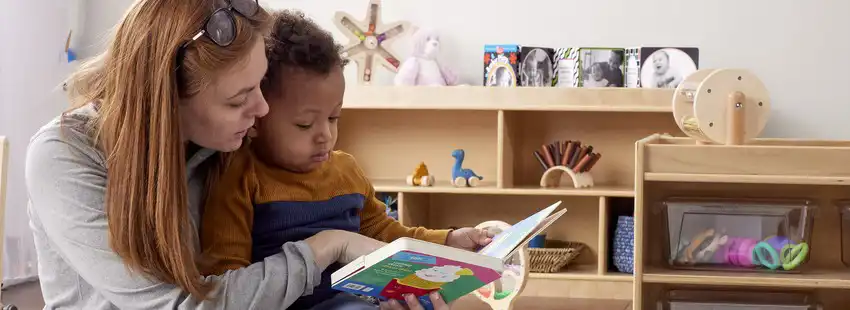
Books are one of the simplest tools in an infant-toddler classroom, and one of the most powerful, especially when we hold the idea of reading together loosely. A baby might mouth the corner of the book while you narrate what's on the page. A toddler might flip straight to the end, point at a picture, and look at you expectantly. Stories get picked up in the middle, pages turn mid-sentence, and reading sessions find their own pace around the urgent work of caregiving. When we embrace the rhythm of sharing books with infants and toddlers, we find joy, connection, language, and real early learning in the process.
Many teachers carry pressure around reading with babies and toddlers the right way. This expectation might include reading every word on a page, following the pages in order, or finishing the story every time. And yet the heart of enjoying books with very young children is connection. Every time a teacher follows a baby's gaze to a picture, names what they see, and waits for a response, that's a serve-and-return exchange — the back-and-forth interaction that literally builds neural pathways. The book is the invitation, and the conversation is the learning.
You can skip pages. You can start in the middle. You can close the book and talk about the cover. You can point to a picture and ask questions, even with a child who can't yet answer in words. The cadence of wonderings and pauses for response time is language development too.
Books Built for Babies
Interactive and Mix-and-Match Books
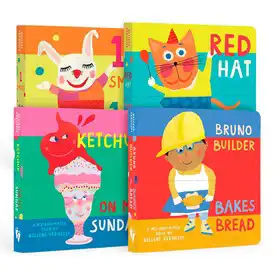
This format invites children to take the lead; combining tops and bottoms, making silly creatures, and driving the conversation. There's no sequence to follow, just endless combinations and plenty of laughter.
Baby-Proof Books and Indestructible
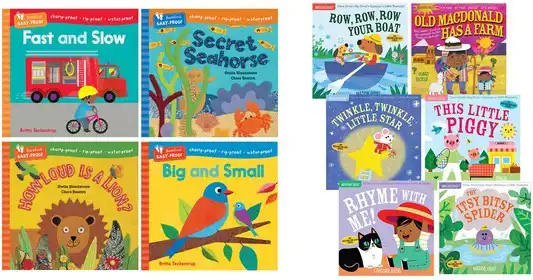
Teachers and children alike are free to engage without worry. When books can be chewed, bent, dropped, and washed, they can go wherever babies go, and the interaction stays relaxed and joyful.
Tummy Time Books
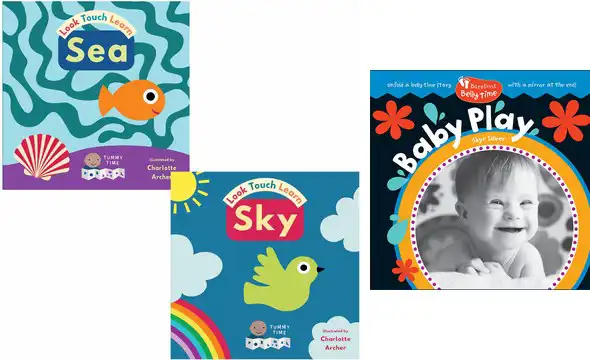
Book formats that are designed to be propped upright offer an engaging format that can turn floor play into a reading moment. Intended to stand up horizontally in front of babies during belly time, they give caregivers an accessible resource for narrating, pointing, and making eye contact.
Guess Who and I Spy-style Books
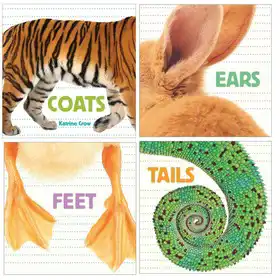
Build in a game from the first page. Books designed with images to invite prediction and conversation — "whose ears do you think those are?" — create natural serve-and-return loops without any pressure to read from start to finish.
Soft and cloth books
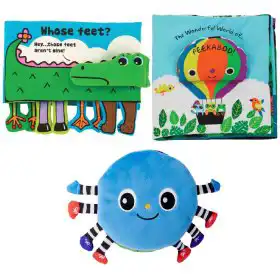
Bring sensory experience into the reading moment. Textured pages, familiar rhymes, and padded covers make these books something babies can hold, explore, and engage with on their own terms.
Permission to Be Imperfect
Supporting infant and toddler literacy doesn't require a perfect read-aloud or an uninterrupted story. Early literacy is about building the conditions — language, warmth, curiosity, connection — that make reading meaningful long before children can decode a single word. Reading with infants and toddlers, done joyfully and often, is exactly how that foundation gets built. And sharing time with books, even when it’s messy and interrupted, is some of the most important work happening in a classroom every day.
Books are one of the simplest tools in an infant-toddler classroom, and one of the most powerful, especially when we hold the idea of reading together loosely. A baby might mouth the corner of the book while you narrate what's on the page. A toddler might flip straight to the end, point at a picture, and look at you expectantly. Stories get picked up in the middle, pages turn mid-sentence, and reading sessions find their own pace around the urgent work of caregiving. When we embrace the rhythm of sharing books with infants and toddlers, we find joy, connection, language, and real early learning in the process.
Many teachers carry pressure around reading with babies and toddlers the right way. This expectation might include reading every word on a page, following the pages in order, or finishing the story every time. And yet the heart of enjoying books with very young children is connection. Every time a teacher follows a baby's gaze to a picture, names what they see, and waits for a response, that's a serve-and-return exchange — the back-and-forth interaction that literally builds neural pathways. The book is the invitation, and the conversation is the learning.
You can skip pages. You can start in the middle. You can close the book and talk about the cover. You can point to a picture and ask questions, even with a child who can't yet answer in words. The cadence of wonderings and pauses for response time is language development too.
Books Built for Babies
Interactive and Mix-and-Match Books
This format invites children to take the lead; combining tops and bottoms, making silly creatures, and driving the conversation. There's no sequence to follow, just endless combinations and plenty of laughter.
Baby-Proof Books and Indestructible
Teachers and children alike are free to engage without worry. When books can be chewed, bent, dropped, and washed, they can go wherever babies go, and the interaction stays relaxed and joyful.
Tummy Time Books
Book formats that are designed to be propped upright offer an engaging format that can turn floor play into a reading moment. Intended to stand up horizontally in front of babies during belly time, they give caregivers an accessible resource for narrating, pointing, and making eye contact.
Guess Who and I Spy-style Books
Build in a game from the first page. Books designed with images to invite prediction and conversation — "whose ears do you think those are?" — create natural serve-and-return loops without any pressure to read from start to finish.
Soft and cloth books
Bring sensory experience into the reading moment. Textured pages, familiar rhymes, and padded covers make these books something babies can hold, explore, and engage with on their own terms.
Permission to Be Imperfect
Supporting infant and toddler literacy doesn't require a perfect read-aloud or an uninterrupted story. Early literacy is about building the conditions — language, warmth, curiosity, connection — that make reading meaningful long before children can decode a single word. Reading with infants and toddlers, done joyfully and often, is exactly how that foundation gets built. And sharing time with books, even when it’s messy and interrupted, is some of the most important work happening in a classroom every day.

Christine Murray, Early Learning Pedagogy and Product Lead
Christine Murray is an Early Learning Pedagogy and Product Lead with Becker’s Education Team.
As an educator, coach and leader, Christine is inspired by the curiosity, joy and wonder that children so generously model for us. She earned her M.A. in Innovative Early Childhood Education at the University of Colorado Denver and loves collaborating with and supporting others in the field. Grounded in relationships and guided by empathy, Christine is always learning, connecting and creating.
Christine Murray, Early Learning Pedagogy and Product Lead
Christine Murray is an Early Learning Pedagogy and Product Lead with Becker’s Education Team.
As an educator, coach and leader, Christine is inspired by the curiosity, joy and wonder that children so generously model for us. She earned her M.A. in Innovative Early Childhood Education at the University of Colorado Denver and loves collaborating with and supporting others in the field. Grounded in relationships and guided by empathy, Christine is always learning, connecting and creating.