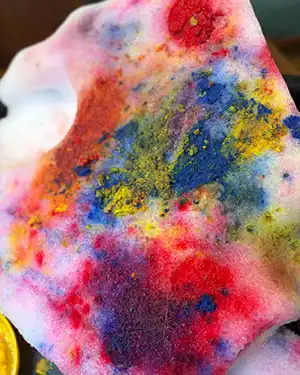
Ice Painting
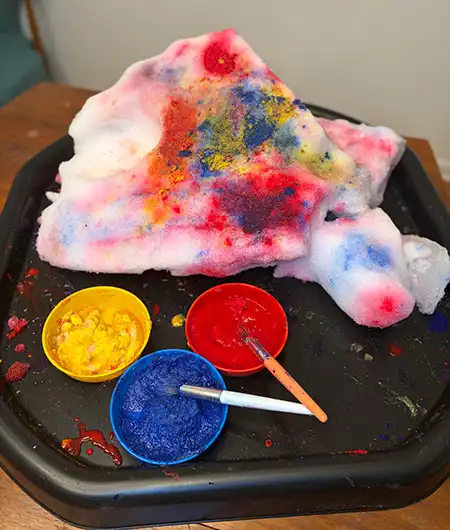
Ice Painting for Preschoolers
Are you looking for a hands-on early childhood learning activity you can do indoors? This ice painting exploration combines sensory play, fine motor development, and early science concepts, all with simple materials you may already have on hand.
Ages/Grades
Preschool, Early Elementary
Learning Domains
Science, Fine Motor
Materials
- • Snow or Ice
- • If you are doing the experiment indoors, you can freeze water in a bin or tray
- • Ice Cubes (1 per student for observations)
- • Tempera Paint (½ cup per student)
- • Kosher salt
- • Feel free to experiment with other salts!
- • Dishes (to mix the salt and paint)
- • Optional items: Brushes, Tray, Marbles, Paint Racers, or Paint & Clay Texture Rollers
Ready, Set, Go!
 Prep the Ice
- Freeze water in a tray. If you live somewhere with snow and ice still outside, you can use a clean piece of ice instead.
 Create the Salt Paste
- Mix salt into ½ cup of tempera paint per child. Add enough salt to create a gritty, thick, paste-like consistency. (The ratio will vary depending on your paint.)
 Observe, Predict, and Discuss
- Invite children to add the salt paste to their ice, then observe:
- • What do you notice?
- • What do you think might change?
- • I wonder what words you would use to describe the texture?
- Invite children to share their experiences with ice. Have they noticed ice melting before? What helped it melt more quickly? Welcome imagination into the conversation: Could a dragon help melt ice?
 Experiment
- Revisit your ice over time.
- Place a small amount of salt paste on the ice and observe what happens at 5 minutes, 10 minutes, and 20 minutes.
- • What do you notice?
- • Does the paste stay in place?
- • Is water forming underneath?
 Extend the Learning
- Remove the paste, rinse with cold water, and observe changes in texture and appearance. For an added challenge, create a path with the paste, scrape it away after 15 minutes, and add a marble to create a homemade marble run.
 What’s Happening?!
- Salt doesn’t directly melt ice — it lowers the freezing point of water. When salt dissolves in the thin layer of water on the ice’s surface, that water can no longer freeze at the same temperature, causing the ice beneath it to melt.